
 搭建项目
搭建项目
# 搭建项目
# 创建项目
vue create vue3-ts-cms

Vue CLI v4.5.15
┌──────────────────────────────────────────┐
│                                          │
│   New version available 4.5.15 → 5.0.4   │
│     Run npm i -g @vue/cli to update!     │
│                                          │
└──────────────────────────────────────────┘

? Please pick a preset: Manually select features
? Check the features needed for your project: Choose Vue version, Babel, TS, CSS Pre-processors, Linter


? Choose a version of Vue.js that you want to start the project with 3.x
? Use class-style component syntax? No
? Use Babel alongside TypeScript (required for modern mode, auto-detected polyfills, transpiling JSX)?
Yes
? Pick a CSS pre-processor (PostCSS, Autoprefixer and CSS Modules are supported by default): Less
? Pick a linter / formatter config: Prettier
? Pick additional lint features: Lint on save
? Where do you prefer placing config for Babel, ESLint, etc.? In dedicated config files
? Save this as a preset for future projects? (y/N) n
2
3
4
5
6
7
8
9
10
11
12
13
14
15
16
17
18
19
20
21
22
23
# 代码规范
# 1.1. 集成.editorconfig 配置
EditorConfig 有助于为不同 IDE 编辑器上处理同一项目的多个开发人员维护一致的编码风格。
# http://editorconfig.org

root = true

[*] # 表示所有文件适用
charset = utf-8 # 设置文件字符集为 utf-8
indent_style = space # 缩进风格(tab | space)
indent_size = 2 # 缩进大小
end_of_line = lf # 控制换行类型(lf | cr | crlf)
trim_trailing_whitespace = true # 去除行首的任意空白字符
insert_final_newline = true # 始终在文件末尾插入一个新行

[*.md] # 表示仅 md 文件适用以下规则
max_line_length = off
trim_trailing_whitespace = false
2
3
4
5
6
7
8
9
10
11
12
13
14
15
VSCode 需要安装一个插件:EditorConfig for VS Code

# 1.2. 使用 prettier 工具
Prettier 是一款强大的代码格式化工具,支持 JavaScript、TypeScript、CSS、SCSS、Less、JSX、Angular、Vue、GraphQL、JSON、Markdown 等语言,基本上前端能用到的文件格式它都可以搞定,是当下最流行的代码格式化工具。
1.安装 prettier
npm install prettier -D
2.配置.prettierrc 文件:
- useTabs:使用 tab 缩进还是空格缩进,选择 false;
- tabWidth:tab 是空格的情况下,是几个空格,选择 2 个;
- printWidth:当行字符的长度,推荐 80,也有人喜欢 100 或者 120;
- singleQuote:使用单引号还是双引号,选择 true,使用单引号;
- trailingComma:在多行输入的尾逗号是否添加,可设置为
none、all - semi:语句末尾是否要加分号,默认值 true,选择 false 表示不加;
{
  "useTabs": false,
  "tabWidth": 2,
  "printWidth": 80,
  "singleQuote": true,
  "trailingComma": "all",
  "semi": false
}
2
3
4
5
6
7
8
3.创建.prettierignore 忽略文件
/dist/*
.local
.output.js
/node_modules/**

**/*.svg
**/*.sh

/public/*
2
3
4
5
6
7
8
9
4.VSCode 需要安装 prettier 的插件

5.测试 prettier 是否生效
- 测试一:在代码中保存代码;
- 测试二:配置一次性修改的命令;
在 package.json 中配置一个 scripts:
"prettier": "prettier --write ."
# 1.3. 使用 ESLint 检测
1.在前面创建项目的时候,我们就选择了 ESLint,所以 Vue 会默认帮助我们配置需要的 ESLint 环境。
2.VSCode 需要安装 ESLint 插件:

3.解决 eslint 和 prettier 冲突的问题:
安装插件:(vue 在创建项目时,如果选择 eslint-prettier,那么这两个插件会自动安装)
npm i eslint-plugin-prettier eslint-config-prettier -D
添加 prettier 插件:
  extends: [
    "plugin:vue/vue3-essential",
    "eslint:recommended",
    "@vue/typescript/recommended",
    "@vue/prettier",
    "@vue/prettier/@typescript-eslint",
    'plugin:prettier/recommended'
  ],
2
3
4
5
6
7
8
# 1.4. git Husky 和 eslint
虽然我们已经要求项目使用 eslint 了,但是不能保证组员提交代码之前都将 eslint 中的问题解决掉了:
也就是我们希望保证代码仓库中的代码都是符合 eslint 规范的;
那么我们需要在组员执行
git commit命令的时候对其进行校验,如果不符合 eslint 规范,那么自动通过规范进行修复;
那么如何做到这一点呢?可以通过 Husky 工具:
- husky 是一个 git hook 工具,可以帮助我们触发 git 提交的各个阶段:pre-commit、commit-msg、pre-push
如何使用 husky 呢?
这里我们可以使用自动配置命令:
npx husky-init && npm install
npx husky-init '&&' npm install # powershell
2
这里会做三件事:
1.安装 husky 相关的依赖:

2.在项目目录下创建 .husky 文件夹:
npx huksy install

3.在 package.json 中添加一个脚本:

接下来,我们需要去完成一个操作:在进行 commit 时,执行 lint 脚本:

这个时候我们执行 git commit 的时候会自动对代码进行 lint 校验。
# 1.5. git commit 规范
# 1.5.1. 代码提交风格
通常我们的 git commit 会按照统一的风格来提交,这样可以快速定位每次提交的内容,方便之后对版本进行控制。

但是如果每次手动来编写这些是比较麻烦的事情,我们可以使用一个工具:Commitizen
Commitizen 是一个帮助我们编写规范 commit message 的工具;
1.安装 Commitizen
npm install commitizen -D
2.安装 cz-conventional-changelog,并且初始化 cz-conventional-changelog:
npx commitizen init cz-conventional-changelog --save-dev --save-exact
这个命令会帮助我们安装 cz-conventional-changelog:

并且在 package.json 中进行配置:

这个时候我们提交代码需要使用 npx cz:
- 第一步是选择 type,本次更新的类型
| Type | 作用 |
|---|---|
| feat | 新增特性 (feature) |
| fix | 修复 Bug(bug fix) |
| docs | 修改文档 (documentation) |
| style | 代码格式修改(white-space, formatting, missing semi colons, etc) |
| refactor | 代码重构(refactor) |
| perf | 改善性能(A code change that improves performance) |
| test | 测试(when adding missing tests) |
| build | 变更项目构建或外部依赖(例如 scopes: webpack、gulp、npm 等) |
| ci | 更改持续集成软件的配置文件和 package 中的 scripts 命令,例如 scopes: Travis, Circle 等 |
| chore | 变更构建流程或辅助工具(比如更改测试环境) |
| revert | 代码回退 |
- 第二步选择本次修改的范围(作用域)

- 第三步选择提交的信息

- 第四步提交详细的描述信息

- 第五步是否是一次重大的更改

- 第六步是否影响某个 open issue

我们也可以在 scripts 中构建一个命令来执行 cz:

# 1.5.2. 代码提交验证
如果我们按照 cz 来规范了提交风格,但是依然有同事通过 git commit 按照不规范的格式提交应该怎么办呢?
我们可以通过 commitlint 来限制提交;
1.安装 @commitlint/config-conventional 和 @commitlint/cli
npm i @commitlint/config-conventional @commitlint/cli -D
2.在根目录创建 commitlint.config.js 文件,配置 commitlint
module.exports = {
  extends: ['@commitlint/config-conventional'],
}
2
3
3.使用 husky 生成 commit-msg 文件,验证提交信息:
npx husky add .husky/commit-msg "npx --no-install commitlint --edit $1"
# 第三方库集成
# 2.1. vue.config.js配置
vue.config.js有三种配置方式:
- 方式一:直接通过CLI提供给我们的选项来配置:
- 比如publicPath:配置应用程序部署的子目录(默认是
/,相当于部署在https://www.my-app.com/); - 比如outputDir:修改输出的文件夹;
- 比如publicPath:配置应用程序部署的子目录(默认是
- 方式二:通过configureWebpack修改webpack的配置:
- 可以是一个对象,直接会被合并;
- 可以是一个函数,会接收一个config,可以通过config来修改配置;
- 方式三:通过chainWebpack修改webpack的配置:
- 是一个函数,会接收一个基于 webpack-chain (opens new window) 的config对象,可以对配置进行修改;
const path = require('path')

module.exports = {
  outputDir: './build',
  // configureWebpack: {
  //   resolve: {
  //     alias: {
  //       views: '@/views'
  //     }
  //   }
  // }
  // configureWebpack: (config) => {
  //   config.resolve.alias = {
  //     '@': path.resolve(__dirname, 'src'),
  //     views: '@/views'
  //   }
  // },
  chainWebpack: (config) => {
    config.resolve.alias.set('@', path.resolve(__dirname, 'src')).set('views', '@/views')
  }
}
2
3
4
5
6
7
8
9
10
11
12
13
14
15
16
17
18
19
20
21
# 2.2. vue-router集成
安装vue-router的最新版本:
npm install vue-router@next
创建router对象:
import { createRouter, createWebHashHistory } from 'vue-router'
import { RouteRecordRaw } from 'vue-router'

const routes: RouteRecordRaw[] = [
  {
    path: '/',
    redirect: '/main'
  },
  {
    path: '/main',
    component: () => import('../views/main/main.vue')
  },
  {
    path: '/login',
    component: () => import('../views/login/login.vue')
  }
]

const router = createRouter({
  routes,
  history: createWebHashHistory()
})

export default router
2
3
4
5
6
7
8
9
10
11
12
13
14
15
16
17
18
19
20
21
22
23
24
安装router:
import router from './router'

createApp(App).use(router).mount('#app')
2
3
在App.vue中配置跳转:
<template>
  <div id="app">
    <router-link to="/login">登录</router-link>
    <router-link to="/main">首页</router-link>
    <router-view></router-view>
  </div>
</template>
2
3
4
5
6
7
# 2.3. vuex集成
安装vuex:
npm install vuex@next
创建store对象:
import { createStore } from 'vuex'

const store = createStore({
  state() {
    return {
      name: 'coderwhy'
    }
  }
})

export default store
2
3
4
5
6
7
8
9
10
11
安装store:
createApp(App).use(router).use(store).mount('#app')
在App.vue中使用:
<h2>{{ $store.state.name }}</h2>
# 2.4. element-plus集成
Element Plus,一套为开发者、设计师和产品经理准备的基于 Vue 3.0 的桌面端组件库:
- 相信很多同学在Vue2中都使用过element-ui,而element-plus正是element-ui针对于vue3开发的一个UI组件库;
- 它的使用方式和很多其他的组件库是一样的,所以学会element-plus,其他类似于ant-design-vue、NaiveUI、VantUI都是差不多的;
安装element-plus
npm install element-plus
# 2.4.1. 全局引入
一种引入element-plus的方式是全局引入,代表的含义是所有的组件和插件都会被自动注册:
import ElementPlus from 'element-plus'
import 'element-plus/lib/theme-chalk/index.css'

import router from './router'
import store from './store'

createApp(App).use(router).use(store).use(ElementPlus).mount('#app')
2
3
4
5
6
7
# 2.4.2. 局部引入(旧)
也就是在开发中用到某个组件对某个组件进行引入:
<template>
  <div id="app">
    <router-link to="/login">登录</router-link>
    <router-link to="/main">首页</router-link>
    <router-view></router-view>

    <h2>{{ $store.state.name }}</h2>

    <el-button>默认按钮</el-button>
    <el-button type="primary">主要按钮</el-button>
    <el-button type="success">成功按钮</el-button>
    <el-button type="info">信息按钮</el-button>
    <el-button type="warning">警告按钮</el-button>
    <el-button type="danger">危险按钮</el-button>
  </div>
</template>

<script lang="ts">
import { defineComponent } from 'vue'

import { ElButton } from 'element-plus'

export default defineComponent({
  name: 'App',
  components: {
    ElButton
  }
})
</script>

<style lang="less">
</style>
2
3
4
5
6
7
8
9
10
11
12
13
14
15
16
17
18
19
20
21
22
23
24
25
26
27
28
29
30
31
32
但是我们会发现是没有对应的样式的,引入样式有两种方式:
- 全局引用样式(像之前做的那样);
- 局部引用样式(通过babel的插件);
1.安装babel的插件:
npm install babel-plugin-import -D
2.配置babel.config.js
module.exports = {
  plugins: [
    [
      'import',
      {
        libraryName: 'element-plus',
        customStyleName: (name) => {
          return `element-plus/lib/theme-chalk/${name}.css`
        }
      }
    ]
  ],
  presets: ['@vue/cli-plugin-babel/preset']
}
2
3
4
5
6
7
8
9
10
11
12
13
14
但是这里依然有个弊端:
- 这些组件我们在多个页面或者组件中使用的时候,都需要导入并且在components中进行注册;
- 所以我们可以将它们在全局注册一次;
import {
  ElButton,
  ElTable,
  ElAlert,
  ElAside,
  ElAutocomplete,
  ElAvatar,
  ElBacktop,
  ElBadge,
} from 'element-plus'

const app = createApp(App)

const components = [
  ElButton,
  ElTable,
  ElAlert,
  ElAside,
  ElAutocomplete,
  ElAvatar,
  ElBacktop,
  ElBadge
]

for (const cpn of components) {
  app.component(cpn.name, cpn)
}
2
3
4
5
6
7
8
9
10
11
12
13
14
15
16
17
18
19
20
21
22
23
24
25
26
27
# 2.4.3 局部按需导入 🔥
首先你需要安装unplugin-vue-components 和 unplugin-auto-import这两款插件
npm install -D unplugin-vue-components unplugin-auto-import
然后把下列代码插入到你的 Vite 或 Webpack 的配置文件中
// vue.config.js
/* eslint-disable @typescript-eslint/no-var-requires */
const AutoImport = require('unplugin-auto-import/webpack')
const Components = require('unplugin-vue-components/webpack')
const { ElementPlusResolver } = require('unplugin-vue-components/resolvers')

module.exports = {
  configureWebpack: {
    plugins: [
      // 自动导入
      AutoImport({
        resolvers: [ElementPlusResolver()],
      }),
      // 自动导入
      Components({
        resolvers: [ElementPlusResolver()],
      }),
    ],
  },
}
2
3
4
5
6
7
8
9
10
11
12
13
14
15
16
17
18
19
20
// vite.config.ts
import AutoImport from 'unplugin-auto-import/vite'
import Components from 'unplugin-vue-components/vite'
import { ElementPlusResolver } from 'unplugin-vue-components/resolvers'

export default {
  plugins: [
    // ...
    AutoImport({
      resolvers: [ElementPlusResolver()],
    }),
    Components({
      resolvers: [ElementPlusResolver()],
    }),
  ],
}
2
3
4
5
6
7
8
9
10
11
12
13
14
15
16
// webpack.config.js
const AutoImport = require('unplugin-auto-import/webpack')
const Components = require('unplugin-vue-components/webpack')
const { ElementPlusResolver } = require('unplugin-vue-components/resolvers')

module.exports = {
  // ...
  plugins: [
    AutoImport({
      resolvers: [ElementPlusResolver()],
    }),
    Components({
      resolvers: [ElementPlusResolver()],
    }),
  ],
}
2
3
4
5
6
7
8
9
10
11
12
13
14
15
16
# 2.5. axios集成
安装axios:
npm install axios
封装axios:
import axios, { AxiosInstance, AxiosRequestConfig, AxiosResponse } from 'axios'
import { Result } from './types'
import { useUserStore } from '/@/store/modules/user'

class HYRequest {
  private instance: AxiosInstance

  private readonly options: AxiosRequestConfig

  constructor(options: AxiosRequestConfig) {
    this.options = options
    this.instance = axios.create(options)

    this.instance.interceptors.request.use(
      (config) => {
        const token = useUserStore().getToken
        if (token) {
          config.headers.Authorization = `Bearer ${token}`
        }
        return config
      },
      (err) => {
        return err
      }
    )

    this.instance.interceptors.response.use(
      (res) => {
        // 拦截响应的数据
        if (res.data.code === 0) {
          return res.data.data
        }
        return res.data
      },
      (err) => {
        return err
      }
    )
  }

  request<T = any>(config: AxiosRequestConfig): Promise<T> {
    return new Promise((resolve, reject) => {
      this.instance
        .request<any, AxiosResponse<Result<T>>>(config)
        .then((res) => {
          resolve((res as unknown) as Promise<T>)
        })
        .catch((err) => {
          reject(err)
        })
    })
  }

  get<T = any>(config: AxiosRequestConfig): Promise<T> {
    return this.request({ ...config, method: 'GET' })
  }

  post<T = any>(config: AxiosRequestConfig): Promise<T> {
    return this.request({ ...config, method: 'POST' })
  }

  patch<T = any>(config: AxiosRequestConfig): Promise<T> {
    return this.request({ ...config, method: 'PATCH' })
  }

  delete<T = any>(config: AxiosRequestConfig): Promise<T> {
    return this.request({ ...config, method: 'DELETE' })
  }
}

export default HYRequest
2
3
4
5
6
7
8
9
10
11
12
13
14
15
16
17
18
19
20
21
22
23
24
25
26
27
28
29
30
31
32
33
34
35
36
37
38
39
40
41
42
43
44
45
46
47
48
49
50
51
52
53
54
55
56
57
58
59
60
61
62
63
64
65
66
67
68
69
70
71
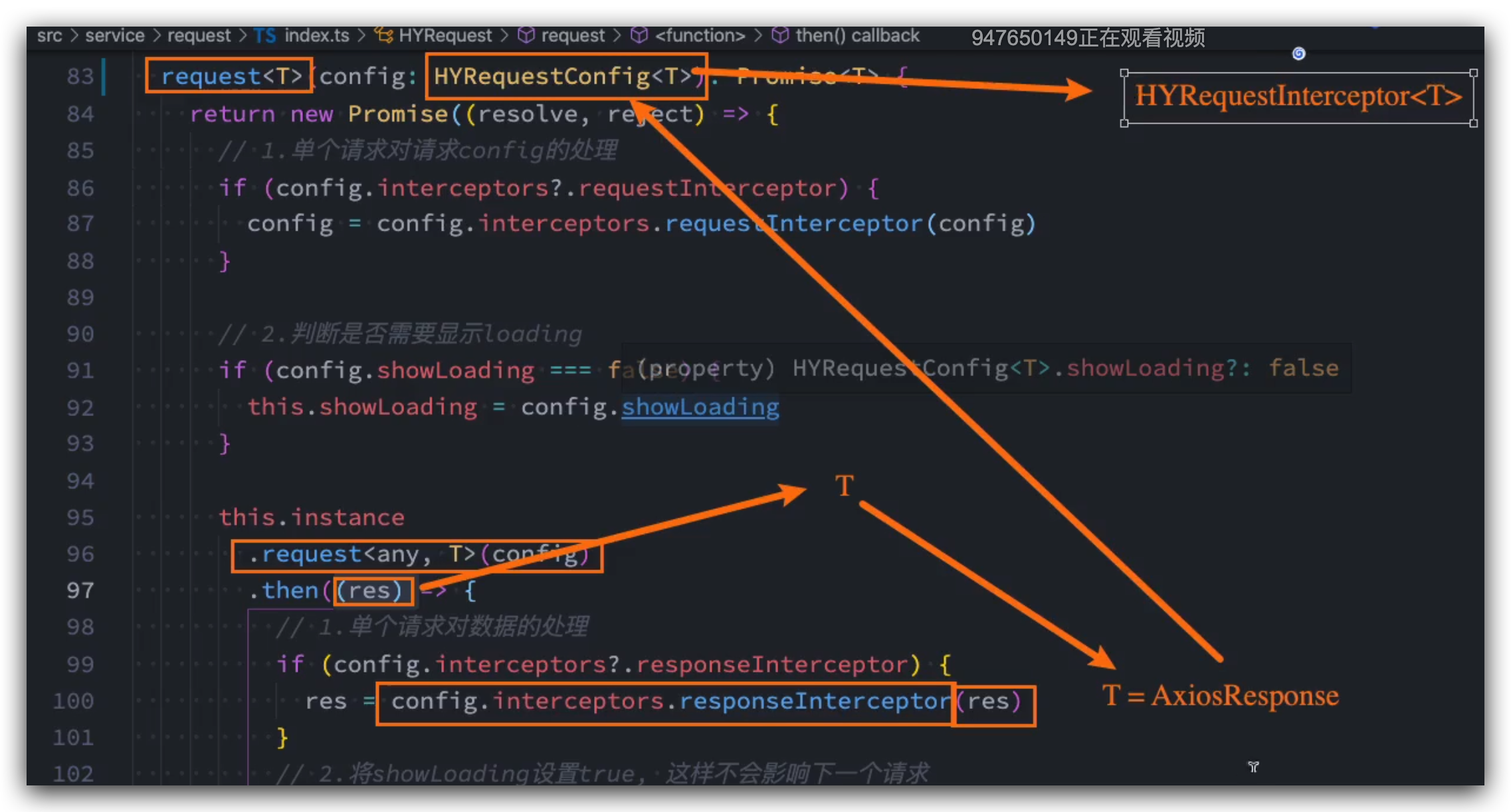
reponseInterceptor 封装泛型问题
# 2.6 环境变量 🔥
在开发中,有时候我们需要根据不同的环境设置不同的环境变量,常见的有三种环境:
- 开发环境:development;
- 生产环境:production;
- 测试环境:test;
如何区分环境变量呢?常见有三种方式:
- 方式一:手动修改不同的变量;
- 方式二:根据
process.env.NODE_ENV的值进行区分; 🔥 - 方式三:编写不同的环境变量配置文件(vue-cli支持的)
// config.ts
// 1.方式一: 手动的切换不同的环境(不推荐)
// const BASE_URL = 'http://coderwhy.org/dev'
// const BASE_NAME = 'coderwhy'

// const BASE_URL = 'http://coderwhy.org/prod'
// const BASE_NAME = 'kobe'

// const BASE_URL = 'http://coderwhy.org/test'
// const BASE_NAME = 'james'

// 2.根据process.env.NODE_ENV区分
// 开发环境: development
// 生成环境: production
// 测试环境: test

let BASE_URL = ''
const TIME_OUT = 10000

if (process.env.NODE_ENV === 'development') {
  BASE_URL = 'http://123.207.32.32:8000/'
} else if (process.env.NODE_ENV === 'production') {
  BASE_URL = 'http://coderwhy.org/prod'
} else {
  BASE_URL = 'http://coderwhy.org/test'
}

export { BASE_URL, TIME_OUT }
2
3
4
5
6
7
8
9
10
11
12
13
14
15
16
17
18
19
20
21
22
23
24
25
26
27
28
Vue-cli 模式和环境变量 (opens new window)
模式是 Vue CLI 项目中一个重要的概念。默认情况下,一个 Vue CLI 项目有三个模式:
development模式用于vue-cli-service servetest模式用于vue-cli-service test:unitproduction模式用于vue-cli-service build和vue-cli-service test:e2e
你可以通过传递 --mode 选项参数为命令行覆写默认的模式。例如,如果你想要在构建命令中使用开发环境变量:
.env.development
VUE_APP_BASE_URL=https://coderwhy.org/dev
VUE_APP_BASE_NAME=coderwhy
2
.env.production
VUE_APP_BASE_URL=https://coderwhy.org/prod
VUE_APP_BASE_NAME=kobe
2
使用
console.log(process.env.VUE_APP_SECRET)
# normalize.css
npm i normalize.css
main.ts
import 'normalize.css'
import './assets/css/index.less'
2
# VSCode配置
{
  "workbench.iconTheme": "vscode-great-icons",
  "editor.fontSize": 17,
  "eslint.migration.2_x": "off",
  "[javascript]": {
    "editor.defaultFormatter": "dbaeumer.vscode-eslint"
  },
  "files.autoSave": "afterDelay",
  "editor.tabSize": 2,
  "terminal.integrated.fontSize": 16,
  "editor.renderWhitespace": "all",
  "editor.quickSuggestions": {
    "strings": true
  },
  "debug.console.fontSize": 15,
  "window.zoomLevel": 1,
  "emmet.includeLanguages": {
    "javascript": "javascriptreact"
  },
  "explorer.confirmDragAndDrop": false,
  "workbench.tree.indent": 16,
  "javascript.updateImportsOnFileMove.enabled": "always",
  "editor.wordWrap": "on",
  "path-intellisense.mappings": {
    "@": "${workspaceRoot}/src"
  },
  "hediet.vscode-drawio.local-storage": "eyIuZHJhd2lvLWNvbmZpZyI6IntcImxhbmd1YWdlXCI6XCJcIixcImN1c3RvbUZvbnRzXCI6W10sXCJsaWJyYXJpZXNcIjpcImdlbmVyYWw7YmFzaWM7YXJyb3dzMjtmbG93Y2hhcnQ7ZXI7c2l0ZW1hcDt1bWw7YnBtbjt3ZWJpY29uc1wiLFwiY3VzdG9tTGlicmFyaWVzXCI6W1wiTC5zY3JhdGNocGFkXCJdLFwicGx1Z2luc1wiOltdLFwicmVjZW50Q29sb3JzXCI6W1wiRkYwMDAwXCIsXCIwMENDNjZcIixcIm5vbmVcIixcIkNDRTVGRlwiLFwiNTI1MjUyXCIsXCJGRjMzMzNcIixcIjMzMzMzM1wiLFwiMzMwMDAwXCIsXCIwMENDQ0NcIixcIkZGNjZCM1wiLFwiRkZGRkZGMDBcIl0sXCJmb3JtYXRXaWR0aFwiOjI0MCxcImNyZWF0ZVRhcmdldFwiOmZhbHNlLFwicGFnZUZvcm1hdFwiOntcInhcIjowLFwieVwiOjAsXCJ3aWR0aFwiOjExNjksXCJoZWlnaHRcIjoxNjU0fSxcInNlYXJjaFwiOnRydWUsXCJzaG93U3RhcnRTY3JlZW5cIjp0cnVlLFwiZ3JpZENvbG9yXCI6XCIjZDBkMGQwXCIsXCJkYXJrR3JpZENvbG9yXCI6XCIjNmU2ZTZlXCIsXCJhdXRvc2F2ZVwiOnRydWUsXCJyZXNpemVJbWFnZXNcIjpudWxsLFwib3BlbkNvdW50ZXJcIjowLFwidmVyc2lvblwiOjE4LFwidW5pdFwiOjEsXCJpc1J1bGVyT25cIjpmYWxzZSxcInVpXCI6XCJcIn0ifQ==",
  "hediet.vscode-drawio.theme": "Kennedy",
  "editor.fontFamily": "Source Code Pro, 'Courier New', monospace",
  "editor.smoothScrolling": true,
  "editor.formatOnSave": true,
  "editor.defaultFormatter": "esbenp.prettier-vscode",
  "workbench.colorTheme": "Atom One Dark",
  "vetur.completion.autoImport": false,
  "security.workspace.trust.untrustedFiles": "open",
  "eslint.lintTask.enable": true,
  "eslint.alwaysShowStatus": true,
  "editor.codeActionsOnSave": {
    "source.fixAll.eslint": true
  }
}
2
3
4
5
6
7
8
9
10
11
12
13
14
15
16
17
18
19
20
21
22
23
24
25
26
27
28
29
30
31
32
33
34
35
36
37
38
39
40
41
# 接口文档
https://documenter.getpostman.com/view/12387168/TzsfmQvw
baseURL的值:
http://152.136.185.210:5000
设置全局token的方法:
const res = pm.response.json();
pm.globals.set("token", res.data.token);
2
接口文档v2版本:(有部分更新)
https://documenter.getpostman.com/view/12387168/TzzDKb12